
How Does Tennis Scoring Work? Points, Games, Sets and Tiebreaks Explained
Learn how tennis scoring works, from love and 15–30–40 points to deuce, advantage, games, sets and match tiebreaks.
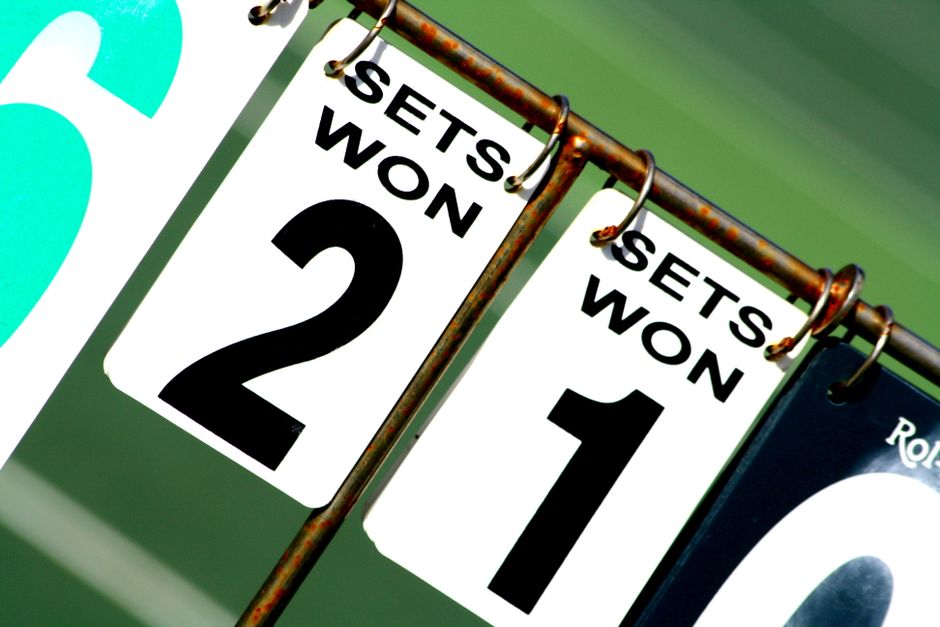
Tennis scoring is built in layers: points make up games, games make up sets, and sets determine the match winner. A player usually needs to win at least six games and lead by two to take a set, while a standard match is won by the player who takes two out of three sets. Men’s singles matches at some major events can require three sets, with the first player to win three sets taking the match.
How points are scored in tennis
Each rally produces one point. The server starts from the right side of the court and alternates sides after every point. The score is announced with the server’s score first.
- 0 points: love
- 1 point: 15
- 2 points: 30
- 3 points: 40
- 4 points: game, provided the player leads by two points
For example, if a player wins the first three points, the score is 40–love. If the receiver wins those points, it is love–40. The unusual terms “love,” “15,” “30” and “40” are simply the traditional names for the point scores.
What do deuce and advantage mean?
At 40–40, the score is called deuce. A player must then win two consecutive points to win the game.
The point after deuce gives one player advantage. If the server wins it, the score is advantage server; if the receiver wins it, the score is advantage receiver. The player with advantage must win the next point to take the game. If the other player wins, the score returns to deuce.
A game can therefore continue well beyond four points. In a standard advantage game, there is no fixed point limit: play continues until one player wins two points in a row after reaching deuce.
How a player wins a game
A player normally wins a game by taking at least four points and leading by two. The basic scoring sequence might be 15–love, 30–love, 40–love and game.
If the score is 40–30, the player with 40 needs one more point. If the player with 30 wins the next rally, the score becomes deuce rather than 40–40 in spoken shorthand. From there, two consecutive points are required.
Some competitions use a no-ad scoring system, especially in doubles or shorter formats. Under no-ad rules, the first player to win the point after 40–40 wins the game. The receiver may usually choose which side to receive from, but the exact procedure depends on the competition rules.
How games make up a set
Most sets use a six-game target. A player wins the set by taking at least six games and leading by two, such as 6–3 or 6–4.
If the score reaches 5–5, one player generally needs to win the next two games to take the set 7–5. If the set reaches 6–6, a tiebreak is normally played instead of continuing indefinitely.
Some formats use a shorter set, an advantage set with no tiebreak at 6–6, or a match tiebreak in place of a deciding set. Tournament regulations should always be checked for the specific event.
How a tennis tiebreak works
In a standard set tiebreak, the first player to reach at least seven points with a two-point lead wins the tiebreak and the set. Scores can therefore finish 7–5, 7–4 or 10–8, but not 7–6.
The player whose turn it is to serve begins with one serve. After that, players serve two points each, switching ends after every six points. A tiebreak at 6–6 is recorded as 7–6 for the set winner, with the tiebreak score often shown separately in brackets.
At many major tournaments, a deciding set that reaches 6–6 uses a match tiebreak. This is commonly played to 10 points with a two-point lead, although the precise rule can vary by event and competition.
How a match is decided
Most professional women’s singles matches and many other tennis matches are best of three sets. The first player to win two sets wins the match. A player who wins the opening two sets does not play a third.
Many men’s singles matches at Grand Slam tournaments are best of five sets. In that format, the first player to win three sets wins the match. Other events, junior competitions, doubles matches and recreational leagues may use best-of-three sets, a match tiebreak or another shortened format.
How serving affects the score
The server is not guaranteed to win the game. Serving gives a player the first chance to control the rally, but either player wins the point when the rally ends.
The server gets two attempts to put the ball into the correct service box. Missing both produces a double fault and gives the receiver the point. A serve that the receiver cannot touch successfully is an ace, which also wins the point for the server. At the end of a game, the players change ends of the court and the receiver becomes the next server.
A simple tennis scoring example
Suppose Player A wins the first point, Player B wins the next two, and Player A wins the following two. The score moves from 15–love to 15–30, then 30–30 and 40–30. If Player A wins the next rally, Player A wins the game. If Player B wins it, the score becomes deuce, and the game continues until one player earns a two-point advantage.
If Player A wins six games while Player B wins four, Player A takes the set 6–4. Winning two sets in a best-of-three match then produces the match victory.