Basketball Rules Explained: A Clear Guide to How the Game Works
Understand the essential basketball rules, including scoring, violations, fouls, timing, possession, substitutions and the main differences between FIBA and NBA games.
Basketball is played by two teams trying to score in the opposing basket while preventing the other side from doing the same. The basic rules are simple: advance the ball legally, stay within the court boundaries, avoid illegal contact and score more points than the opponent before time expires.
Most international competitions use rules published by FIBA, while the NBA has several important variations. Youth, school and recreational leagues may also adjust court dimensions, game length or foul limits. The principles below explain the standard rules and highlight the differences that commonly cause confusion.
How basketball is played
A standard basketball team has five players on the court at one time. Players usually take roles such as point guard, shooting guard, forward and center, but the rules do not require a player to stay in one position. Teams can substitute players during permitted stoppages in play.
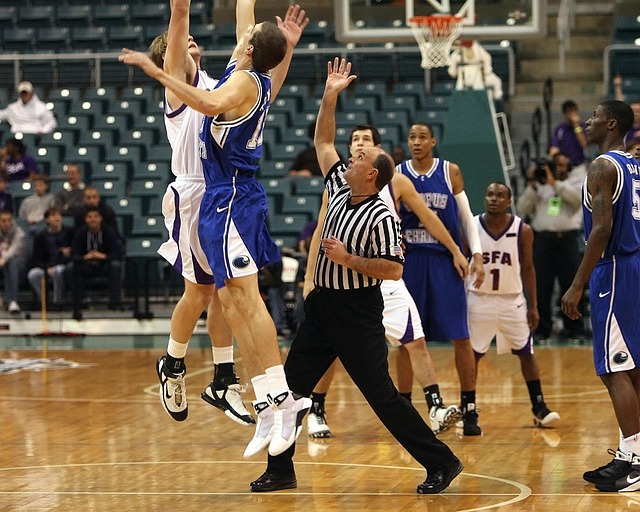
The game begins with a jump ball at center court. After the opening tip, possession is normally controlled through an alternating-possession arrow in FIBA games. In the NBA, most jump-ball situations are resolved with another jump ball. The team in possession attacks one basket and must defend the other; the direction changes after halftime.
Scoring in basketball
- Free throw: 1 point.
- Field goal inside the three-point line: 2 points.
- Three-point field goal: 3 points when the shooter releases the ball from behind the three-point arc.
A player must release the shot before stepping on or beyond the three-point line for it to count as three points. If the player lands beyond the line after releasing the ball, the shot can still be worth three points. Officials judge the shooter’s position at the moment of release.
A basket normally counts when the ball passes completely through the hoop from above. If a defender illegally interferes with a shot that is descending toward the basket, the officials may award the attacking team points through goaltending or basket-interference rules.
Moving the ball: dribbling and passing
A player may move with the ball by dribbling it continuously with one hand or by passing it to a teammate. A player who receives the ball can usually take two steps while gathering the ball and then must pass, shoot or establish a legal pivot foot.
Traveling
Traveling occurs when a player moves illegally while holding the ball. Common examples include taking extra steps after ending a dribble, changing the pivot foot illegally or falling and then rolling or standing while still holding the ball. The exact interpretation of the gather step can vary slightly between competitions, but the player cannot gain extra movement by repeatedly repositioning the feet.
Double dribble
A player cannot stop dribbling, hold the ball and then start a new dribble unless an opponent touches the ball, another player touches it or the player loses control because of a shot or pass. Dribbling with both hands at the same time also ends the dribble.
Carrying or palming
Carrying happens when a player places the hand underneath the ball or otherwise allows the ball to come to rest while dribbling. The hand should remain on top or to the side of the ball as it is pushed toward the floor.
Out-of-bounds rules
The ball is out of bounds when it touches the floor, a person or an object outside the boundary lines. It is also out of bounds if a player holding or touching the ball steps on a boundary line or outside the court. The last team to touch the ball generally loses possession.
A throw-in restarts play from the sideline or baseline. The inbounder must release the ball within the time allowed by the competition and cannot step onto the court before releasing it. A player may not be the first person to touch the ball after a throw-in unless another player has touched it.
Time limits and possession rules
Basketball uses several clocks to prevent teams from holding the ball indefinitely:
- Game clock: Measures the playing time in each period.
- Shot clock: Requires the attacking team to attempt a shot within a set time. In FIBA and NBA basketball, the standard limit is 24 seconds.
- Eight-second rule: In FIBA and NBA play, the offense must move the ball from its backcourt into the frontcourt within eight seconds.
- Three-second rule: An attacking player may not remain in the opponents’ restricted area for too long while the team controls the ball in the frontcourt.
- Five-second limits: Some situations, such as closely guarded play or a throw-in, require an action within five seconds under the relevant competition rules.
The shot clock normally resets when the opposing team gains control, and it may reset to a shorter period after certain offensive rebounds or defensive fouls, depending on the rules being used. A shot that leaves the shooter’s hand before the buzzer may count if it later goes through the basket.
Fouls and illegal contact
A foul is usually illegal physical contact or unsporting conduct. Examples include pushing, holding, blocking an opponent’s movement illegally, charging into a legal defender, striking an opponent or restricting a player’s freedom of movement with the hands.
Personal fouls
Personal fouls are recorded against players. A defender can be penalized for illegal contact against a shooter, ball handler or cutter. An offensive player can commit a charging foul by creating illegal contact with a defender who has established a legal guarding position.
If a player is fouled while shooting, the result depends on the shot. A successful two-point attempt normally includes one additional free throw, while a successful three-point attempt includes one additional free throw. A missed two-point shot generally produces two free throws, and a missed three-point shot produces three, provided the shooter was fouled during the attempt.
Team fouls and bonus free throws
Team fouls are counted within each period. Once a team reaches the applicable limit, later defensive fouls may lead to free throws even when the player was not shooting. The threshold and penalty differ between FIBA, NBA, college and local competitions, so the scoreboard or competition regulations should be checked.
Technical and unsportsmanlike fouls
A technical foul can result from behavior such as disrespectful conduct, excessive arguing, delay of game or an illegal player action that is not ordinary physical contact. FIBA also uses the term unsportsmanlike foul for contact that is excessively hard, unnecessary or designed to stop a promising attack without a legitimate play on the ball. More serious conduct may lead to disqualification or ejection.
Defense and legal guarding
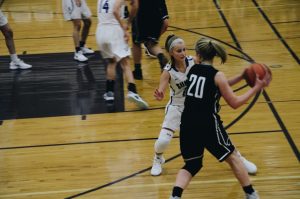
A defender may move to stay in front of an opponent, contest a shot and attempt to steal the ball. The defender must give the opponent enough space to stop or change direction when establishing a legal guarding position. A defender cannot simply step into an opponent’s path at the last moment and claim a charge if the position was not established legally.
Defenders may use their torso to absorb contact when they are in a legal position, but they may not use extended arms, hips, legs or hands to push, hold or impede the ball handler. Contact is not automatically a foul; officials consider who created the illegal contact and whether the contact affected the play.
Substitutions, timeouts and game structure
Substitutions are made during permitted dead-ball situations. A substitute must report correctly and enter only after the official allows the change. Teams can call timeouts to stop the clock and organize their next play, but the number and timing of timeouts vary by competition.
FIBA games consist of four 10-minute quarters. NBA games use four 12-minute quarters. Overtime periods are five minutes in both systems, and additional overtime periods are played if the score remains tied. Youth and school competitions may use different quarter lengths.
FIBA and NBA rule differences
The main concepts are shared, but international and NBA basketball are not identical. The NBA court is wider and longer than the standard FIBA court, and the three-point arc is at a different distance. The NBA also uses a defensive three-second rule, which limits how long a defender may remain in the lane without actively guarding an opponent. FIBA does not use that rule in the same form.
Other differences include the number and administration of timeouts, the treatment of possession after certain stoppages, defensive goaltending details and the handling of team-foul penalties. A rule that produces a turnover in one competition may result in a different restart in another. For official games, the competition’s published rulebook takes priority over general basketball explanations.
Common basketball rule questions
Can a player catch their own missed shot?
Yes, if the ball was a genuine shot attempt. A player generally cannot throw the ball against the backboard or floor and catch it without making a legitimate shot, pass or contact with another player, because that may be treated as an illegal self-pass or violation.
Can a player step on the three-point line?
Yes, as long as the player is not touching the line while releasing the shot. A shot released with the foot on the line is a two-point attempt, not a three-pointer.
What happens after a violation?
Most violations, including traveling, double dribbling and stepping out of bounds, give the other team a throw-in from the nearest appropriate location. A shot-clock or backcourt violation also normally changes possession.
What is a jump ball situation?
A jump ball situation occurs when opponents have equal control of the ball, the ball becomes lodged between the backboard and rim, officials cannot determine who last touched it or another rule calls for a held-ball restart. The method used to decide possession depends on the competition.
What to watch for during a game
To follow basketball rules in real time, watch the player’s feet when a dribble ends, the position of defenders before contact, the shot-clock display and the boundary lines. The referee’s hand signals also help: a rotating fist indicates traveling, a hand moving down usually indicates a dribbling violation, and a raised arm often signals a foul.
The result of a controversial play can depend on details such as who had possession, whether a shot had started, whether the defender was set and which rulebook governs the game. That is why professional leagues sometimes use video review for close decisions involving scoring, out-of-bounds possession, shot-clock timing and flagrant or unsportsmanlike contact.