
How Long Is a Tennis Match? Typical Duration Explained
A tennis match usually lasts between 60 minutes and three hours, but the format, surface, scoring system, and number of long games can change the total significantly.
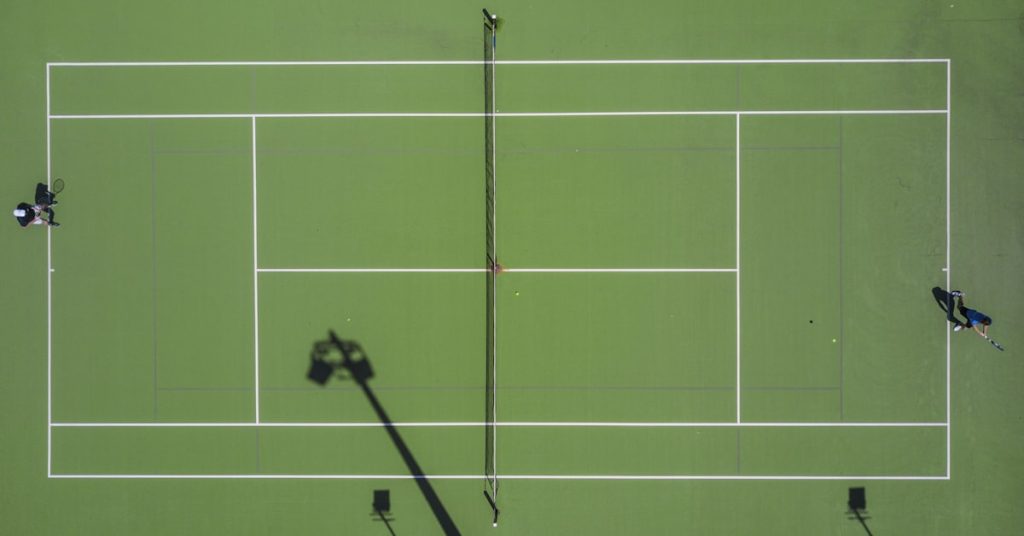
The length of a tennis match depends mainly on the scoring format and how closely the players are matched. A typical professional best-of-three match lasts about 90 minutes to two and a half hours, although some finish in under an hour while others extend beyond three hours. Best-of-five matches, commonly used in men’s Grand Slam singles, often take two to four hours or more.
Average tennis match duration
For most singles matches, the following ranges provide a useful estimate:
- Best-of-three sets: about 60 to 150 minutes in many professional matches.
- Best-of-five sets: about two to four hours, with longer contests possible.
- Amateur and recreational matches: often 60 to 120 minutes, depending on the players’ level and the agreed scoring format.
- Doubles matches: commonly shorter than singles matches when a match tiebreak replaces a deciding set.
These are approximate playing-time estimates rather than fixed limits. Tennis has no standard clock that ends a match after a set period. The match finishes when one player or team wins the required number of sets, so the score and pace matter more than the scheduled court time.
Why tennis matches vary so much in length
Number of sets
A best-of-three match ends when a player wins two sets. It can therefore finish in straight sets or require a deciding third set. A best-of-five match requires three winning sets, which creates more opportunities for the contest to continue. A straight-set match may be relatively quick, while a five-set battle can last several hours.
Close games and deuce points
Games won comfortably usually take little time. A game that reaches deuce can contain several additional points because a player must establish a two-point advantage under traditional scoring. Repeated deuces, long rallies, and changes in momentum can add many minutes without adding another game to the scoreboard.
Tiebreaks
A tiebreak often resolves a set faster than continuing with ordinary games, but it is not always brief. Long tiebreaks can include extended rallies and multiple changes of serve. The rules for a deciding-set tiebreak also vary by competition, so the final set may end differently at a Grand Slam, tour event, or local tournament.
Playing style and surface
Fast courts can produce shorter points and more service holds, while clay courts generally encourage longer rallies and more breaks of serve. Surface alone does not determine match length, because player styles and the score are also influential. Two aggressive servers may finish quickly, whereas defensive players may create a longer physical contest on the same court.
Breaks and interruptions
Changeovers, set breaks, medical timeouts, toilet breaks, treatment, weather delays, and court maintenance can all extend the total time between the first serve and the final point. The official match duration may therefore be much longer than the time spent actively hitting the ball.
How long is a Grand Slam tennis match?
Grand Slam singles matches use different formats depending on the competition. Women’s singles matches are generally best of three sets, while men’s singles matches are traditionally best of five. As a result, a three-set women’s match and a five-set men’s match can have very different average durations, even when the points are played at a similar pace.
Grand Slam matches can also last longer because players face high-level opponents, deciding sets may be tightly contested, and tournament rules include scheduled rest periods between sets or during extreme conditions. A match that reaches the maximum number of sets is not automatically a record-length contest; the number of deuce games, tiebreak points, rallies, and interruptions also matters.
How long is a tennis set and a tennis game?
A tennis game often takes between two and ten minutes, but a straightforward service game can be completed faster and a deuce game can last much longer. A set commonly takes 30 to 60 minutes. A set with many short games may finish in around 20 minutes, while a close set with lengthy games and a long tiebreak can take well over an hour.
A match consists of points, games, and sets. The scoring structure explains why the clock is unpredictable: a player needs four points to win a game only if they lead by two, six games to win a standard set only if they lead by two, and two or three sets to win depending on the match format.
Singles versus doubles match length
Doubles matches are often shorter because many competitions use a match tiebreak instead of a full deciding set. This format can reduce playing time, but it does not guarantee a quick match. Fast serving, frequent net play, and shorter rallies may shorten points, while a close score can still produce a long contest.
Rules differ between professional tours, junior events, college tennis, club competitions, and recreational play. Some formats use no-ad scoring, in which the next point after deuce decides the game. Others use short sets or match tiebreaks. Checking the event rules is more reliable than assuming every tennis match follows the traditional format.
What is the longest a tennis match can last?
There is no single universal maximum duration for a tennis match. The practical limit depends on the competition’s scoring rules, court schedule, weather policy, player welfare rules, and any deciding-set tiebreak. Before deciding-set tiebreaks became more common at major events, exceptionally close matches could continue for many hours because the final set required a two-game advantage.
Even with a tiebreak, an unusually long match remains possible if games reach repeated deuces, the deciding set is close, or play is interrupted. A match lasting more than four hours is unusual for best-of-three tennis but is plausible in a long best-of-five contest.
Planning time to watch or play
Someone attending a recreational match can usually allow around two hours, including warm-up and changeovers. For a professional best-of-three match, reserving three hours is safer than relying on the average. A best-of-five match may require four or five hours of availability, particularly if the players are evenly matched.
Television coverage can last longer than the match itself because of introductions, analysis, interviews, advertisements, and delays. Conversely, a scheduled court time is not a reliable prediction of the finish because tennis tournaments commonly run behind schedule after earlier matches last longer than expected.